One of the most confusing things about spinal problems is that the pain often shows up somewhere else. People arrive convinced they have a calf problem, a hamstring injury, or something wrong with the hip. The scan shows a healthy leg and a compressed nerve root in the lower back.Many people come to us sure …

One of the most confusing things about spinal problems is that the pain often shows up somewhere else. People arrive convinced they have a calf problem, a hamstring injury, or something wrong with the hip. The scan shows a healthy leg and a compressed nerve root in the lower back.
Many people come to us sure they have a calf, hamstring or hip problem. Their scan shows a healthy leg and a squeezed nerve root in the back. (A nerve root is the start of a nerve, where it leaves the spine.)
Nerves are long
The nerves to your legs leave the spine in your lower back, then run through the buttock, thigh and calf to the foot.
A nerve irritated anywhere can be felt along its whole length. Your brain reads the signal as coming from the far end. In awake patients having spinal surgery, touching a nerve root brought on their leg pain, not back pain.
That is why treating the leg rarely helps.

Which level produces which symptom
Each nerve root roughly serves its own strip of the leg:
– L4: the front of the thigh and the inner lower leg.
– L5: the outer calf, the top of the foot and the big toe.
– S1: the back of the thigh and calf, the sole and the outer foot.
These maps are only a guide. Textbook versions disagree, and in one study pain in the buttock, thigh or calf could come from L3, L4, L5 or S1. Your symptoms and scan should broadly agree, not exactly.
Pain in one leg more often means pressure on one side of the canal. Pain in both legs more often means narrowing in the middle.

Why both legs, or only one
Which legs are affected tells you something about where the compression sits.
Compression to one side of the canal affects the nerve roots on that side, and tends to produce symptoms in one leg.
Central narrowing, where the canal itself is tight, affects nerves running down the middle, which serve both sides. Clinical classifications of spinal stenosis distinguish a radicular type, following one or two nerve root distributions, from a central type with aching or burning in both legs. So bilateral symptoms more often reflect central canal narrowing, and one-sided symptoms more often a lateral or foraminal problem. It is a tendency rather than a rule.
There is a third pattern worth knowing: different levels affecting different sides. A disc pressing left at one level and right at another produces symptoms in both legs from two separate causes.

Pain, tingling, numbness, weakness
You will often hear these described as a fixed sequence, with pain first and weakness last. The real picture is less tidy, and worth stating accurately.
Different nerve fibres respond differently to being compressed. Large-diameter fibres are more vulnerable than small ones, and in lumbar radiculopathy specifically it is the large fibres carrying vibration and temperature sense that show measurable dysfunction, while the smaller pain-carrying fibres are relatively preserved. Both how hard a nerve root is compressed and how long it stays compressed determine how badly conduction is affected.
So rather than a strict order, think of it as degrees of involvement:
Pain means the nerve is irritated and inflamed but still conducting.
Tingling and shock-like sensations mean conduction is disturbed.
Numbness means sensory conduction is significantly impaired.
Weakness means the motor fibres are affected and the nerve is struggling to carry the signals that move your muscles.

The tight hamstring that isn't a tight hamstring
Many people with lumbar nerve irritation notice their hamstrings and calves are persistently tight, and stretch them endlessly without result.
The reason is that raising a straight leg does not only stretch the hamstring, it tensions the sciatic nerve and pulls on the nerve roots inside the spinal canal. Where a root is already irritated, the limit to the movement is nerve sensitivity rather than muscle length, and stretching harder pulls on an inflamed nerve.
This can be separated out in examination: adding a movement at a distant joint, such as turning the hip in or pulling the ankle up, tensions the nerve further without changing the muscle, which helps distinguish symptoms of neural from musculoskeletal origin.
Settle the nerve irritation, and the tightness usually eases with it.
Why the pain sometimes stops
Occasionally, pain that has been radiating down the leg settles while the underlying problem remains. This can mean one of two very different things.
It can mean the inflammation has genuinely resolved and the nerve has settled. This is common, and it is exactly what recovery looks like. It is also worth knowing that herniated disc material is often cleared by the body on its own; pooled across eleven studies, about two thirds of herniations resorbed under conservative care.
Less commonly, it can mean the nerve has become compressed to the point where it is no longer transmitting properly; and here you would expect pain to be replaced not by comfort, but by numbness, weakness, or a change in what the leg can do.
The distinction is important, and it is decided by what has replaced the pain. Relief with normal sensation and normal strength is recovery. Loss of feeling or power is not.
Why the pain keeps going
Most sciatica follows a cycle:
1. Something narrows the space around a nerve root: a bulging disc, a disc losing height, a thickened ligament or a narrow canal.
2. The pinched nerve becomes irritated and inflamed. That is what hurts, and it is felt down your leg.
3. The muscles and ligaments around the spine tighten to protect the area. This is called guarding, or spasm.
4. That tightness squeezes the spine further and keeps the nerve irritated. So the pain builds instead of settling.
This is why so much sciatica responds to conservative treatment: inflammation and tight muscles can be relieved.
Where Ojaswi Wellness comes in
Sciatica is one of the most common problems we treat. Most of it comes from inflammation and guarding muscles, not fixed damage.
At our residential centre in Varkala, Kerala, we treat this cycle in two steps, and the order matters:
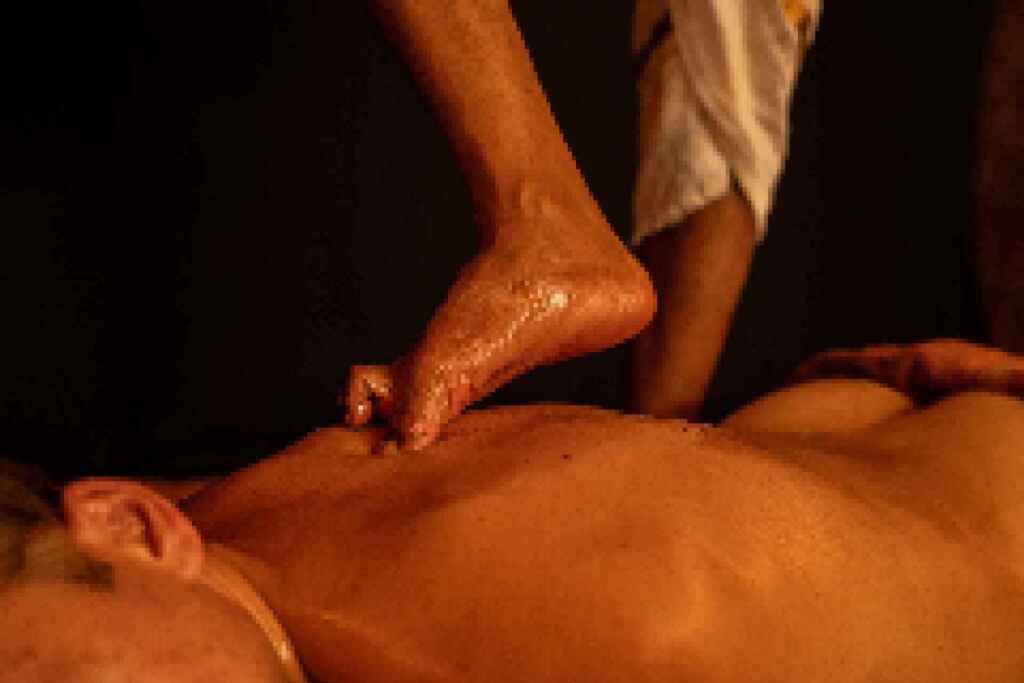
1. Release – Kalari Marma therapy loosens the tightened muscles and ligaments around the spine. This settles the inflammation around the irritated nerve, which usually eases the leg pain.
2. Decompression – Once the tissue has released, we use manual decompression to restore space between the vertebrae and take pressure off the nerve.
Most patients need 14 days of daily treatment, followed by a rest period and a short strengthening routine we teach you before you go home. Treatment, stay and meals are included in one cost.
Send us your MRI report and your symptoms. We will tell you where your pain is coming from and what we can do about it.
Book a Consultation
It’s easy and free!