People often arrive at Ojaswi with a reasonable question: what exactly is this treatment, and how is it supposed to help a disc problem?It deserves a straight answer, without mysticism and without overclaiming.The traditionKalari Marma therapy comes from the Kalaripayattu tradition of Kerala, one of the oldest martial systems in the world. Alongside the fighting …

People often arrive at Ojaswi with a reasonable question: what exactly is this treatment, and how is it supposed to help a disc problem?
It deserves a straight answer, without mysticism and without overclaiming.
The tradition
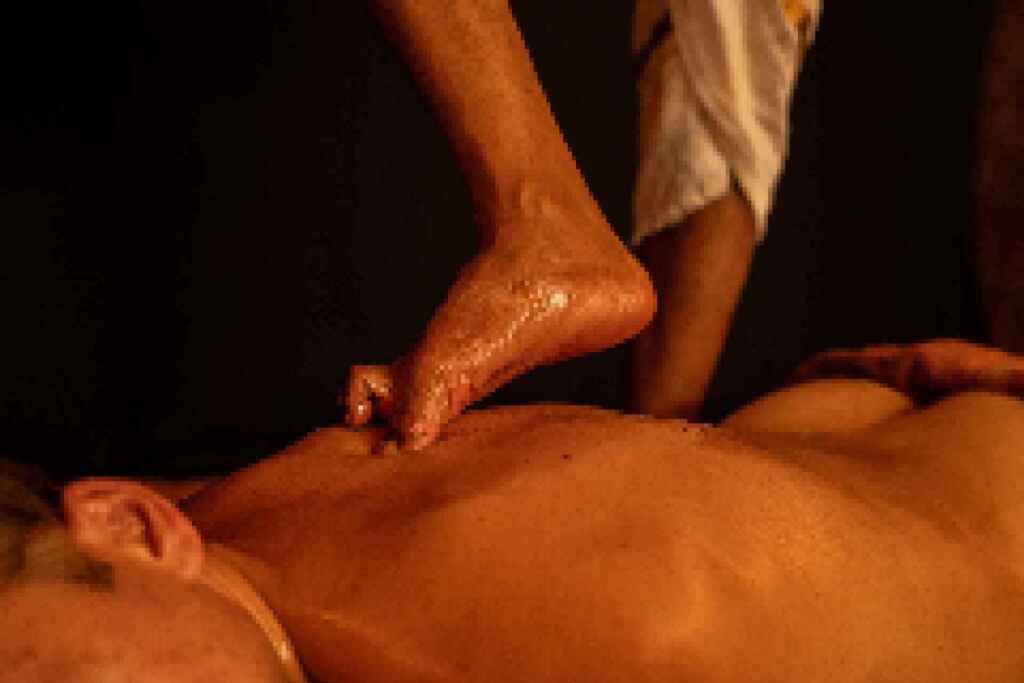
Kalari Marma therapy comes from the Kalaripayattu tradition of Kerala, one of the oldest martial systems in the world. Alongside the fighting art, it developed a detailed therapeutic system, a body of knowledge about the vital points of the body, the ligaments and muscles, and how to release and restore them.
It is closely related to Ayurveda, shares much of its understanding of the body, and has been practised in Kerala for centuries. It is a hands-on tradition: what it offers is skilled manual work, developed and refined over generations.
What follows explains the mechanism we are working on, the manual therapy, and the exercise that follows it.
The problem it addresses
To explain what the treatment does, it helps to understand what actually happens to a spine over years of load.
Discs lose height. The vertebrae sit closer together. The openings the nerves pass through narrow. So far, this is structural.
But something else happens alongside it, and it is often the larger part of the problem.
The muscles and ligaments around the spine tighten. Partly this is wear. Mostly it is protection, when a segment is painful or unstable, the body braces around it to limit movement. It is an intelligent response in the short term.
Over months and years, though, it becomes counterproductive. That chronic tightness compresses the spine further, reducing the space available to nerves that already have too little. It restricts movement, which starves the discs of the nutrition they get only through motion. And the tight tissue is itself painful.
You can often see this on an MRI report. When a report describes “straightening of the spine due to paraspinal muscle spasm” or “loss of normal lumbar lordosis,” it is describing muscles pulling hard enough to flatten the natural curve of the spine. That is not a small amount of tension.
So the picture is a cycle: compression causes inflammation, inflammation causes guarding, guarding causes more compression. It builds rather than settles, which is why chronic back pain so often gets worse over years rather than better.

What we do
The treatment works in two stages, and the order matters.
First, release. We work on the ligaments and muscles surrounding the spine to release the accumulated tightness. This settles the inflammation around irritated nerve roots and breaks the guarding cycle described above. It is the stage that usually produces the earliest relief, because so much of chronic back pain is muscular in origin.
Then, decompression. Once the soft tissue has released, we perform manual decompression of the spinal column, specialised hands-on techniques to restore space between the vertebrae. This cannot be done first. Attempting decompression on a spine locked in spasm achieves little and risks a good deal.
With that space restored, pressure on the nerve roots reduces and the discs gain room. Over the following months, bulged disc material can gradually recede and annular tears are given the conditions to heal.

What the evidence says about manual therapy generally
Manual therapy as a category has, and the picture is modest rather than dramatic.
The American College of Physicians recommends massage and spinal manipulation among first-line options for acute back pain. The UK’s NICE guideline says manual therapy, manipulation, mobilisation or soft-tissue techniques such as massage, should be considered only as part of a treatment package that includes exercise.
We think that last condition is the important one, and we have built our programme around it. The manual work is not the treatment on its own; it is the part that makes the exercise possible.
What it does not do
We would rather be honest about the limits than lose your trust later.
Manual therapy cannot reverse advanced structural degeneration. A heavily degenerated disc will not return to its original height. Bone spurs do not dissolve. A bony canal cannot be widened by hand.
Where degeneration is still early, particularly in younger patients, genuine recovery of disc quality is possible once the load comes off, and we will say so where we think it applies to you. What we will not do is offer that expectation to someone whose discs are well past that stage.
For serious disc degeneration, we never promise full recovery, but we do have alternative therapies to reduce the strain on the disc by reducing the inflammation. In such cases the focus is on arresting further degeneration and improving quality of life through progressive improvements.
Why the fortnight is not the treatment
This is the point we most want patients to understand before they book.
The days in our centre create the opportunity. Space is restored, inflammation settles, tissue releases. But a disc that has been compressed for years does not recover in fourteen days, and a spine returned immediately to the load that damaged it will simply be compressed again.
What follows the treatment is what determines the outcome:
The exercises rebuild the muscular support that holds the spine in position, so that load is carried by muscle rather than by disc.
Our rest period is a clinical judgement about protecting a healing annular tear in the weeks after treatment, not a trial-proven intervention, and we will discuss its length and what it involves with you individually rather than applying a template. If you have concerns about it, raise them with us; and with your own doctor.
Your routine immediately post-treatment determines the effectiveness of the treatment. Diligently observing the rest-period followed by consistency of exercise routines allow the body to strengthen and recover. The body returns to the healthiest state progressively.
Personalised consultation on lifestyle corrections helps identify the cause of the spinal compression and guides you towards achieving a healthier lifestyle, eliminating chances of re-occurrence for a lifetime, provided you follow the lifestyle recommendations.
Get your MRI report analysed
Everything begins with your report. Our Marma Therapy experts review each one and share a personalized note on what your scan shows, what is causing your symptoms, what we believe treatment can achieve, and what it cannot. This assessment warrants no charge and no obligation.
If you have been living with back or leg pain for years, have been told there is nothing to be done short of surgery, or simply want someone to explain your scan properly; start there.
Send us your MRI report and your history. We will tell you honestly whether we can help, including if the answer is no.
Book a Consultation
It’s easy and free!