These four terms appear on almost every spine MRI report, and they are not interchangeable. Understanding the difference tells you a great deal about how serious your situation is and how it is likely to respond. What a disc is Between every two vertebrae sits a disc. Think of it as a firm jelly-filled cushion: …

These four terms appear on almost every spine MRI report, and they are not interchangeable. Understanding the difference tells you a great deal about how serious your situation is and how it is likely to respond.
What a disc is
Between every two vertebrae sits a disc. Think of it as a firm jelly-filled cushion: a tough fibrous outer wall called the annulus, and a softer gel centre called the nucleus.
The disc absorbs shock, spreads load, and allows your spine to bend and twist.
One fact about discs explains most spinal problems: discs have no blood supply of their own. They are the largest avascular structures in the body, and cells at the centre of an adult disc can sit as far as 8 mm from the nearest blood vessel.
Nutrition reaches them by diffusion, oxygen and glucose seeping slowly inward from small vessels in the bone at the top and bottom surfaces of the disc. It is a marginal supply even in a healthy spine.
Movement matters, but not quite in the way it is usually described. You will often hear that walking “pumps” nutrition into the disc. Fluid does move in and out with load, it is why you are fractionally taller in the morning than at night, but for the small molecules the cells actually need, that flow contributes far less than diffusion does. This has been tested directly: an animal study in the 1980s found fluid pumping during movement had an insignificant effect on nutrient transport, a computer model of a full day’s loading found the same, and a 2025 experiment on loaded disc tissue found no transport advantage from loading over the first 24 hour.

What loading and posture do change is how solutes are distributed once inside. A recent study of 20 volunteers using contrast-enhanced MRI found that standing drives solutes out of the nucleus while lying down favours uptake; so movement is not irrelevant, it simply is not a pump feeding the disc.
What sustained loading does is degrade the route. Hours of continuous compression squeeze water out and the disc loses height, which changes the distance nutrients must travel. Over years, the bone surfaces the nutrients pass through thicken and calcify, narrowing the supply line further. Movement also signals the disc cells to maintain their matrix, and both too much load and too little are harmful to that process; a disc that is never unloaded gets neither.
Remove the movement, through hours of sitting, or standing still, or riding, and the disc is under continuous pressure with a supply that was never generous to begin with. Over years it dries out and loses height. Radiologists call this desiccation or dehydration, and it is where nearly every disc problem begins.
The four stages
Disc bulge. The disc has flattened slightly and spread outward around its whole circumference, like a tyre losing pressure. The outer wall is intact. This is the earliest and most recoverable stage.
Disc protrusion. A portion of the disc pushes out further than the rest; a focal outward push rather than a general spread. The outer wall is stretched but still contains the material.
Disc herniation or prolapse. Disc material has pushed fully through the outer wall. This is the stage where a fragment can press directly on a nerve root, and it is why herniations often produce more dramatic leg symptoms than bulges.
Annular tear or fissure. A tear in the outer wall of the disc. This can exist alongside any of the above, and it deserves a section of its own.

Why annular tears matter more than people expect
Patients often see “annular tear” on a report, note that the report also says “no nerve compression,” and assume there is not much wrong.
Two things make that reading a mistake.
First, the outer wall of the disc has its own pain fibres. Anatomical work going back to 1981 showed the outer annulus is innervated, and in painful degenerate discs those nerve fibres grow inward into territory that is normally nerveless. During spinal surgery on awake patients under local anaesthetic, stimulating the outer annulus reproduced the patients’ back pain. A tear there produces genuine, deep, persistent pain in its own right, independently of whether any nerve is compressed.
Second, a tear can cause leg pain without compressing anything. When the wall tears, inflammatory chemicals from inside the disc leak out and reach the nearby nerve root. The nerve becomes chemically irritated and inflamed even though nothing is physically pressing on it, and it sends pain signals along its full length, down the leg, sometimes to the foot.

This is well established rather than speculative. Applying disc material to a nerve root with no mechanical compression at all produced measurable nerve injury in animal studies, with TNF-alpha implicated as the mediator. In humans, a study of 42 patients with leg pain, an annular tear and no herniation found the tear’s position corresponded to where the pain was felt.
This is genuinely good news when it applies to you. Chemical irritation settles as inflammation resolves. Nothing has to be moved out of the way, because nothing is in the way.
Why tears need rest specifically
An annular tear heals the way any tear in fibrous tissue heals: when it is not being repeatedly pulled apart.
Every time you sit for a long stretch, bend forward, or lift something, pressure inside the disc rises and pushes outward against the tear. The healing that took place overnight is undone by the morning commute.
This is the whole reason treatment for disc problems includes a rest period afterwards, and why that period is not optional. The treatment relieves the pressure. The rest is what allows the tear to close. Skipping it means paying for the first part and discarding the second.
Something surprising about how these resolve
Here is a finding that runs against intuition, and against what most patients are told.
The more dramatic-sounding stages are the ones most likely to resolve on their own. Disc material that has pushed fully through the wall; the herniations and sequestrations that sound worst on a report; is recognised by the body as something to break down and reabsorb. Contained bulges, which sound milder, do not get cleared the same way.
The figures from a systematic review of spontaneous regression: sequestration regressed in 96% of cases, extrusion in 70%, protrusion in 41%, and bulging in 13%. A separate meta-analysis of 11 studies found an overall resorption rate of about 67% under conservative treatment. The mechanism is that extruded fragments are exposed to the blood supply, which allows immune cells in to clear them.
We tell patients this because it matters twice over. If you have a herniation, the outlook is better than the word suggests. And if anyone, including us, claims credit for a herniation resorbing, you should know that a good proportion of them do so anyway.
What treatment and rehabilitation address is the other part: the inflammation around the nerve, the muscular guarding, and the load that caused the problem and will otherwise cause it again.
Age matters too. A disc at 25 holds far more water and heals faster than the same disc at 60. This is why we are more optimistic with younger patients, and more careful about what we promise to older ones.
What this means for you
If your report says bulge, you are early, but note that contained bulges are the least likely to clear spontaneously, so the rehabilitation side matters most here.
If it says protrusion with an annular tear, you have a genuine pain source and a reasonable chance of natural improvement.
If it says herniation or extrusion with nerve compression, the picture sounds worse than it usually turns out to be, but this is also the stage where you should have a proper clinical assessment, because it is where nerve function can be affected.
Whatever stage you are at, the mechanics are the same: relieve the pressure, allow healing, rebuild the support. The details differ; the principle does not.
Treatment at Ojaswi Wellness
Disc problems are what we treat, and stage matters, which is why we ask to see your report before saying anything about a plan.
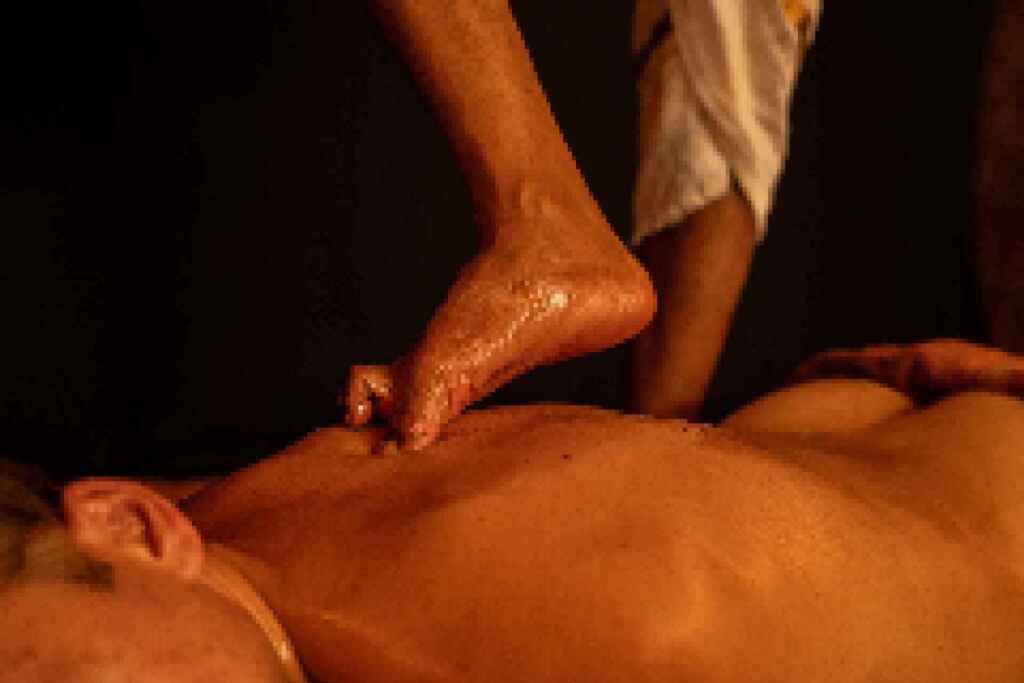
Our approach uses Kalari Marma therapy in two stages. First we release the ligaments and muscles that have tightened around the spine, settling the inflammation around irritated nerve roots. Then we perform manual decompression to restore space between the vertebrae, taking pressure off the disc so a tear can close and a bulge can begin to recede.
Most patients need fourteen days of daily sessions, followed by a rest period matched to their findings and a strengthening programme we teach before they leave.
An annular tear is the point at which acting genuinely changes the trajectory. Left under load, it tends to progress. Given decompression and proper rest, it heals.
Send us your MRI report. Abhijith Gurukkal will review it personally and tell you what stage you are at and what can be done about it.
Book a Consultation
It’s easy and free!